
One missing clause can turn a family trust into a foreign trust.
Taxpartna reads the trust deed alongside the financials, so a missing foreign person exclusion is flagged before lodgment, not after the revenue office finds it.
See how it worksWatch how Taxpartna flags a trust deed with no foreign person exclusion.
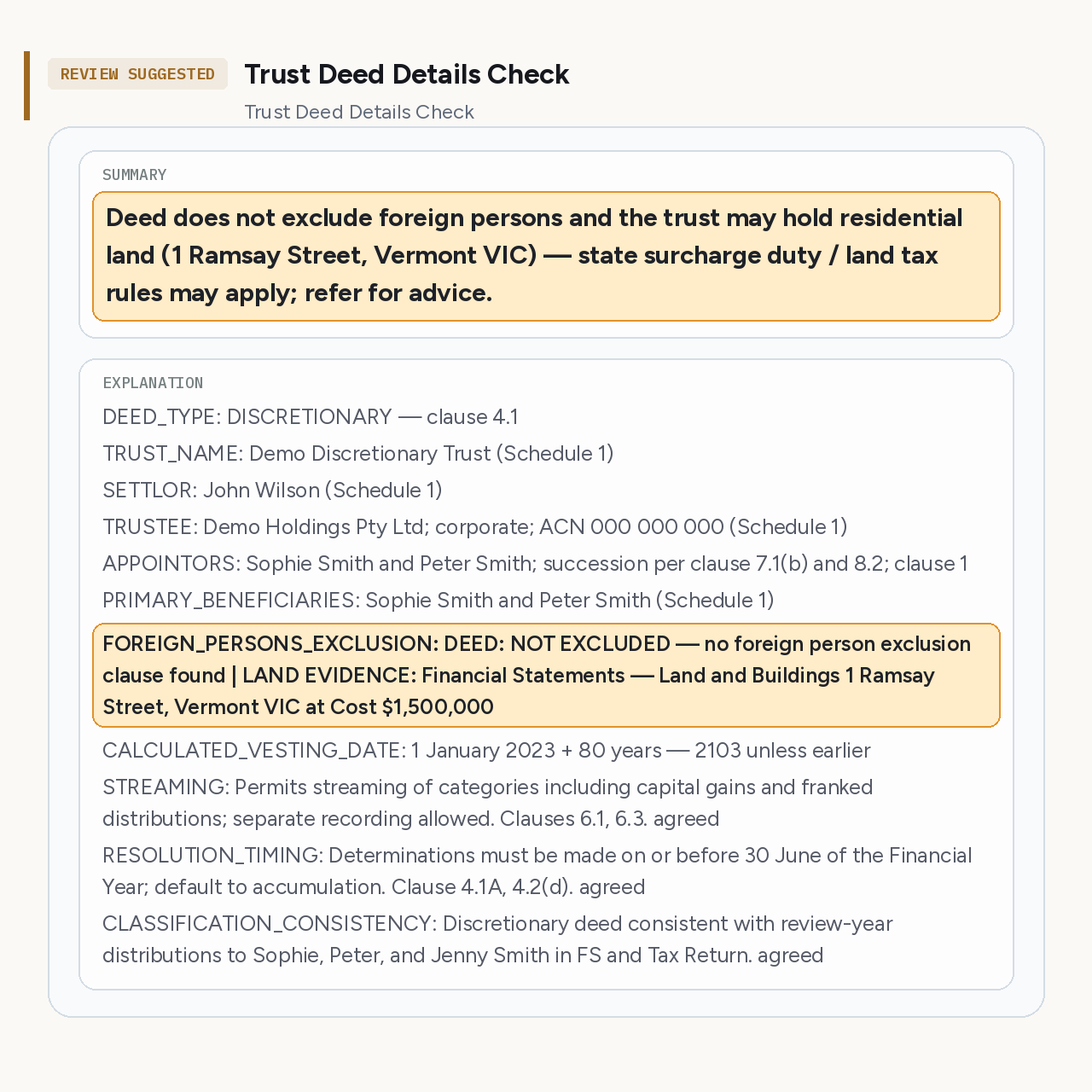
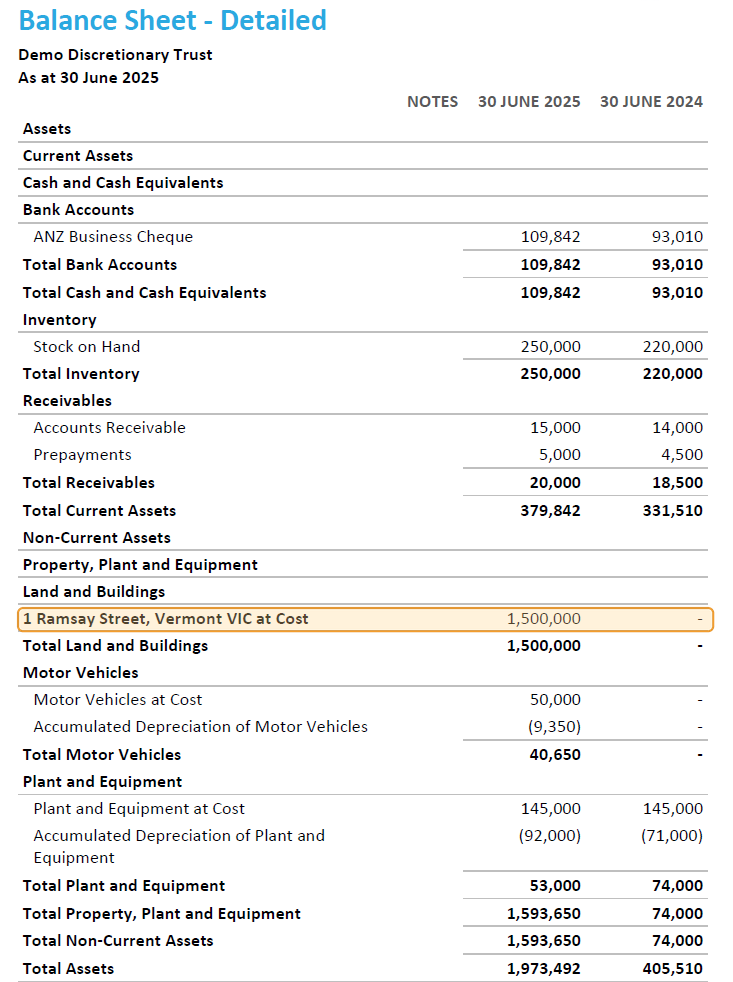
Here is what it found in the demo trust: the deed result, and the land on the balance sheet that triggered it.
Why the deed matters
No distribution needed
In Victoria and NSW, a discretionary trust can be treated as a foreign trust if a foreign person is, or could become, a beneficiary. That can apply even if the trustee never distributes to them.
Residential land is the trigger
Where the trust holds or buys residential land, foreign surcharge duty on the purchase and surcharge land tax each year can apply on top of the usual duty and land tax.
The answer sits in the deed
The revenue offices generally look for a deed that excludes foreign persons as beneficiaries and cannot be amended to let them back in. A general statement of intent is not enough.
Older deeds carry the risk
Many family trust deeds were drafted before these rules and have not been read since the trust was set up. The question rarely comes up at year end unless someone checks.
Other states apply the test differently
The check is built around NSW and Victoria, the two biggest markets for these surcharges. Even there the bar differs: NSW wants an exclusion that cannot be undone, while Victoria (and Tasmania) accept one in place before the purchase. Queensland, SA and WA look further, at default beneficiaries, the trustee and the appointor, so the same deed can get a different answer from state to state. The ACT looks only at named beneficiaries and charges land tax, not surcharge duty. Where the land is outside NSW or Victoria, treat the flag as a prompt to check that state’s rules.
What the Trust Deed Details Check looks at
Upload the trust deed with the job and Taxpartna reads it, then cross-checks it against the financial statements and tax return.
What it confirms
- Deed type: discretionary, unit or other, with the clause reference.
- Trust details: trust name, settlor and trustee, including a corporate trustee and its ACN.
- Appointors: who they are and how succession works under the deed.
- Primary beneficiaries: as named in the schedule.
- Foreign persons exclusion: whether the deed excludes foreign persons, cross-checked to any land in the financial statements.
- Vesting date: calculated from the deed.
- Streaming: whether capital gains and franked distributions can be streamed and recorded separately.
- Resolution timing: when distribution resolutions must be made, and what happens by default.
- Consistency: whether the distributions in the financial statements and tax return match what the deed allows.
A flag, not a ruling
Taxpartna marks the item “Review suggested” and shows the reason: the missing clause and the land it found. Whether a surcharge applies, and whether the deed should be varied, remains a decision for the practitioner and, where needed, a lawyer.
Getting the best result: for trust reviews, include the trust deed and any deed variations with the financial statements, the full tax return and the workpaper pack. The full upload list is in the user guide.
Run your next completed trust job through Taxpartna.
Illustrative demo data. Foreign surcharge rules and rates differ by state and change over time. Check current guidance from the State Revenue Office Victoria, Revenue NSW or the relevant state revenue office.